Blog

Drink Driving is No Small Matter: How Does New South Wales Law Define It?

Article overview:

  • How is drink driving defined in NSW?
  • Is drink driving a criminal offense?
  • Recommendation


Recently, a serious traffic accident allegedly caused by drink driving occurred in Sydney, New South Wales (NSW), Australia, resulting in one person being seriously injured. The driver involved was arrested by the police after refusing to take the alcohol test, but was granted conditional bail (including handing over her passport and reporting to the police office regularly) after receiving approval from the judge. The entire case is currently awaiting hearing in court.

This accident quickly became the focus of media attention, once again sounding the alarm that “ drink driving = high risk + high cost.” In New South Wales, drink driving is not only a traffic violation, but may also constitute a criminal offense. It is crucial for all road users to understand the relevant laws and possible consequences. 

How is drink driving defined in NSW?

In Australia, drink driving is measured in two main ways:

1. PCA – Prescribed Concentration of Alcohol 

It is mainly measured through breath tests, which refer to the concentration of alcohol in exhaled air, and is a commonly used indicator by police in random roadside drunk driving tests.

Can you refuse a roadside alcohol test?

Absolutely not! In New South Wales, police can stop you at any time to conduct a breath test, and can also require all drivers involved in a traffic accident to cooperate. Refusing an initial screening or subsequent breath/blood test is a serious crime in itself, and the penalty is usually equivalent to that for high-level drunk driving.

2. BAC – Blood Alcohol Content 

If the driver’s breath test (PCA) shows an excessive level, the police may request a blood test to obtain more accurate alcohol concentration data.

New South Wales has different legal limits depending on the alcohol content in the blood. Specifically, driving with an excessive blood alcohol concentration refers to exceeding the following alcohol concentrations in 210 liters of breath or 100 milliliters of blood:

  • Novice range PCA: For learner and provisional drivers),BAC > 0
  • Low range PCA:BAC 0.05–0.079
  • Mid range PCA:BAC 0.08–0.149
  • High range PCA:BAC > 0.15


In addition to the above two drink driving charges, there is another charge called DUI (Driving Under the Influence of Alcohol or Drugs): This refers to a driver who is unable to safely control their vehicle due to the influence of alcohol or other substances (including some prescription drugs).

*Penalties for DUI and PCA charges are similar. If convicted of drink driving, you may face license revocation, fines, and imprisonment in cases of multiple convictions or severely excessive blood alcohol concentration.

Is drink driving a criminal offense in New South Wales?

In New South Wales, drink driving is a criminal offense, and the severity of the penalties reflects the importance Australian law places on public safety.

Whether you are a first-time offender or a repeat offender, there is a high probability that you will have a criminal record. If you are facing such charges, it is recommended that you seek professional legal advice as soon as possible to obtain the best legal advice for your case. A lawyer will guide you through the steps you should take before trial, and the outcome of the case will often be more favorable.

Take driving with an excessive blood alcohol concentration (PCA) as an example. The penalties for drink driving in New South Wales include: 

  • Low-range drink driving (0.05-0.079) penalties may include:
    • If it is your first offense, the fine is $704; if the case goes to court, the fine can be up to $2,200.
    • Police have the authority to immediately suspend your driving license for up to three months.
    • For a second or subsequent offense, the fine may be up to $3,300, and the court has the authority to suspend your driving license for up to six months, and you may be required to participate in an alcohol interlock program.
  • Moderate drink driving (0.08-0.149) penalties may include:
    • Upon court conviction, a first offense may result in a fine of up to $2,200, a minimum 6-month driving disqualification, a maximum 9-month imprisonment, being required to participate in an alcohol interlock program, or a 12-month license suspension.
    • For a second or subsequent offense, penalties may include a maximum fine of AUD 3,300, a minimum driving disqualification of 12 months, a maximum imprisonment of 12 months, being required to participate in an alcohol interlock program, or having the driver’s license revoked for 3 years.
  • High-level drink driving (0.15 or above) penalties may include:
    • For first-time offenders, a maximum fine of AUD 3,300, a minimum 12-month driving disqualification, a maximum 18-month prison sentence, mandatory participation in an alcohol interlock program, or a long-term driving license revocation.
    • For a second or subsequent offense, penalties may include a maximum fine of AUD 5,500, a minimum driving disqualification of 24 months, a maximum imprisonment of 24 months, being required to participate in an alcohol interlock program, or a long-term license suspension.


*For second or subsequent offenses, penalties will become more severe, including higher fines, longer prison terms, and longer disqualification periods. It is recommended that you seek legal advice from a lawyer in a timely manner to ensure you receive the most appropriate legal advice and avoid an unfavorable outcome in your case.


The Alcohol Interlock Program

The Alcohol Interlock Program is a court-mandated program for certain drunk driving offenders. If you are convicted of a drunk driving offense, or if you are convicted of two or more drunk driving offenses, you will be required to drive only vehicles equipped with an alcohol interlock device for a certain period of time after your driving privileges are reinstated.


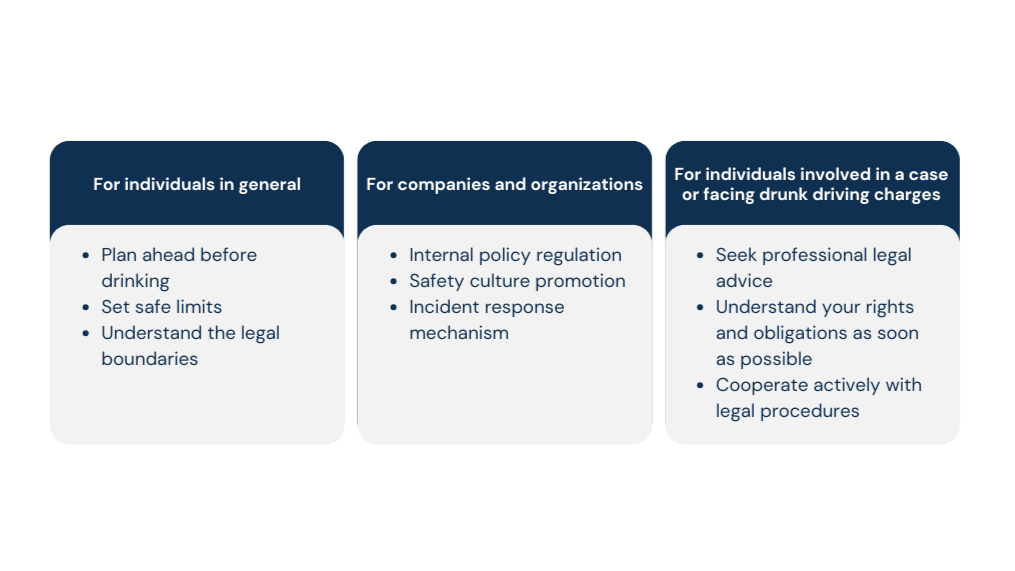
Recommendations

For individuals in general:

  1. Plan ahead before drinking: Arrange for a designated driver, public transportation, or a ride-hailing service in advance before going out to avoid last-minute luck.
  2. Set safe limits: Even if you believe you have consumed a moderate amount of alcohol, you may still exceed the legal limit. The safest approach is to “never drink and drive”.
  3. Understand the legal boundaries: Familiarize yourself with legal standards and penalties for different levels of exceeding the limit. Understanding the legal consequences is more reliable than simply relying on your tolerance for alcohol.


For companies and organizations:

  1. Internal policy regulation: For positions that require employees to drive, clearly define alcohol testing requirements and disciplinary procedures.
  2. Safety culture promotion: Regularly organize training on drunk driving laws and safety, and incorporate risk awareness into daily management.
  3. Incident response mechanism: If an employee is involved in drunk driving, immediately contact legal counsel, assess the risk, and take remedial measures.


For individuals involved in a case or facing drunk driving charges:

  1. Seek professional legal advice: Before being questioned, preparing for court, or signing any documents, contact a qualified lawyer to help assess the nature of the charges and possible legal consequences. A lawyer can help you analyze whether the police evidence and procedures are compliant and develop a strategy based on your situation. The earlier you seek legal assistance, the more likely you are to avoid unnecessary mistakes and lay the groundwork for a more favorable outcome in the future.
  2. Understand your rights and obligations as soon as possible: After receiving notification from the police or being stopped for inspection, promptly confirm your legal rights to information and defense to avoid being at a disadvantage due to unfamiliarity with the process.
  3. Cooperate actively with legal procedures: Whether it is appearing in court, paying fines, or complying with temporary driving restrictions, you should comply promptly to reduce additional legal risks.

Written by Xueying Yang; Content planning: Gang Sun, Xueying Yang; Proofreading: Gang Sun, Ming Zhao, David Ho

This article is provided by Sunfield Chambers Solicitors & Associates. The content of this article is based on publicly available information and the author’s understanding, and does not constitute any form of professional legal advice or basis for business decisions. Readers should refer to this article in the context of their own actual situation and consult relevant professionals for specific guidance. The author and the publishing platform do not assume legal responsibility for any consequences arising from the use of the information in this article.  

Consultation with Specialized Lawyers

Ming Zhao

Partner, Solicitor

Ming is proficient in immigration law and has over 20 years of experience in this area of law. He specialises in business skills migration, employer nomination scheme, employer nomination migration in regional areas, etc. Also, Ming is highly experienced in all areas of criminal defence, including matters involving drink driving, drive while disqualified/suspended, etc.

David Ho

Solicitor

David’s main practice areas are criminal defence and immigration law. He assists client in defending criminal proceedings and assist with visa and/or citizenship applications. David is always dedicated irrespective of the complexity of the matters, and he is always diligent and practical.

Abraham Sun

Principal Solicitor

As the Principal Solicitor, Abraham has been working with numerous clients including listed companies, state-owned enterprises, ultra-high-net-worth clients, and investment banks. Customers in various industries including Australian and Chinese companies and individual investors, had achieved considerable economic benefits with his professional legal advice.

Dickson Luo

Solicitor

Dickson mainly conducts dispute resolutions and commercial litigation in areas across insolvency, corporations, employment, real property and consumer law. He is proficient in English and Chinese Mandarin, and have extensive experience acting for clients who have limited or no English skills in complex disputes and litigation matters.