


Over recent years, the legal industry has been undergoing a major transformation due to technological developments and innovations. Legal Tech Companies driven by new technology are disrupting the market landscape led by Traditional Law Firms. In the legal industry, the form of data is text-based, and the vast majority of it is based on legal provisions and real cases, which is well suited for the training of large language models and naturally an excellent scenario for AI learning. This shift represents a significant step in Legal Market Trends, showcasing the growing role of AI in reshaping business model in legal service.

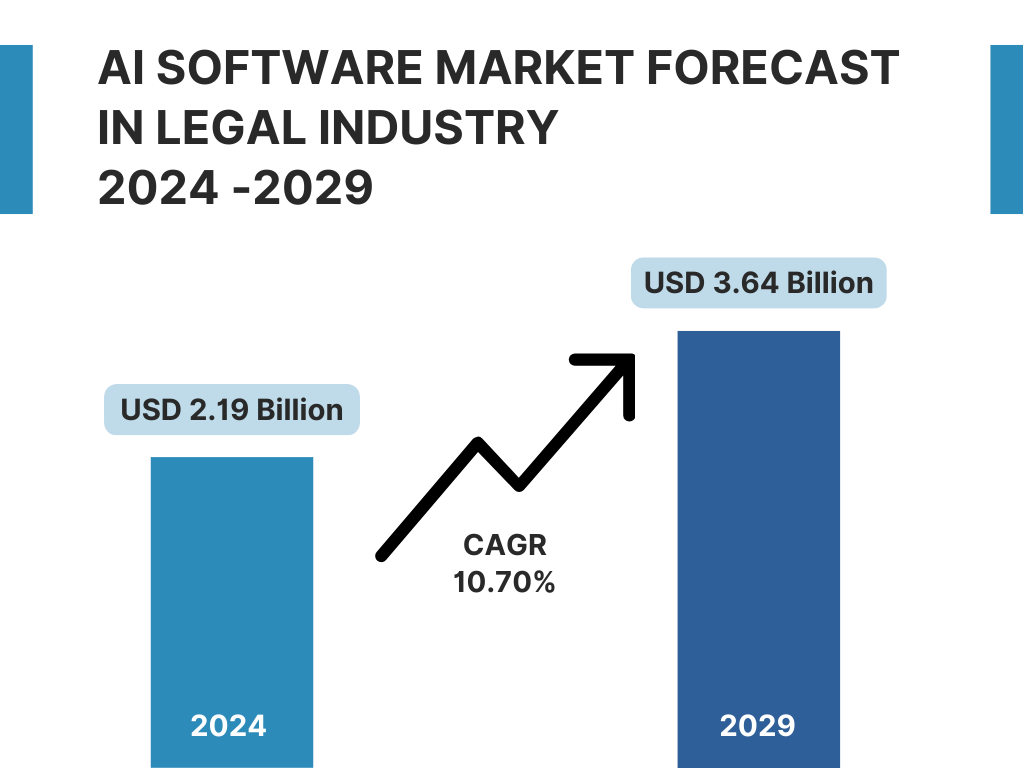
Artificial intelligence software market for legal industry is expected to grow from USD 2.19 billion in 2024 to USD 3.64 billion by 2029, at a compound annual growth rate (CAGR) of 10.70% during the forecast period (2024-2029). This innovative technology-based solution to streamline processes, reduce costs and increase efficiency is receiving industry attention. A key factor behind this growth is the increasing demand for Legal Process Optimization and Decision Support tools, allowing firms to enhance productivity while maintaining compliance.
So, how exactly does the business model of a legal tech company differ from that of a traditional law firm? And what does the future hold for the legal industry? In this article, we will provide an in-depth comparison and analysis of each business model.
This image is an original creation by the author based on relevant data and materials. The copyright belongs to Sunfield Chambers Solicitors & Associates. Unauthorized reproduction, modification, or commercial use in any form is prohibited. For reprinting, please cite the source and contact marketing@schambers.com.au for permission.
1. Legal technology companies
1.1 What is a legal technology company?
A legal technology company is characterized as an innovative company that is technology-driven at its core and utilizes technology (mainly artificial intelligence and large language models) to provide legal services. The software technology mainly utilizes Generative AI, based on the understanding of natural language and deep learning, which can process complex text-based information.
These companies can be divided into two types:
- Companies that provide legal software to law firms with the aim of assisting lawyers with repetitive matters: for example, LexisNexis is a Legal AI software designed for the legal industry that provides online services for retrieving strategic news and business information. Such software often includes intelligent document processing and data analysis features to streamline research and case preparation. These types of companies specialize in developing and delivering software tools that help law firms improve efficiency, manage cases and clients, conduct legal research, and more. They usually do not provide legal services directly, but rather provide support to lawyers.
- Companies that provide legal services directly to users and aim to simplify the process of providing legal services: for example, LegalZoom allows users to describe their legal needs and obtain the required legal documents through a simple online interface. By leveraging legal technology, these platforms automate document processing and deliver standardized legal solutions at scale. For instance, if a user needs to register a trademark, he or she simply selects the relevant service on the website and answers questions step-by-step, ultimately obtaining a trademark application document that meets the specifications. This type of company focuses on non-litigation services such as patent applications, trademark registrations, wills and living trusts.
1.2 Advantages of legal technology companies
- Lower cost of services: Through standardized and intelligent processes, the otherwise high cost of services has been greatly reduced, enabling more clients to access legal services at lower cost. This economical feature is particularly suited to individuals and small businesses with limited budgets.
- Faster Response: Utilizing technology, the platforms offered by these firms are able to quickly handle tedious tasks such as contract review, significantly reducing client wait times and in turn increasing client satisfaction.
- Easier touchpoints: Users can easily access the legal services they need through online platforms or mobile apps, eliminating the time and effort required for face-to-face communication. This convenience attracts a large number of users who want to solve their legal problems quickly.
- Expanding the scope of services: due to the nature of their online platforms, legal tech companies are able to cover a wider market and break down regional restrictions, making legal services accessible to geographically inaccessible client groups.
1.3 limitations of legal tech companies
- Limited personalized services: due to the standardized processes of intelligent platforms, this prevents them from providing in-depth legal advice and solutions when dealing with complex and personalized legal needs, which may not meet the needs of specific clients.
- Highly technology-dependent: the stability of the service is highly dependent on the technological infrastructure, and technological failures or data security issues may adversely affect a client’s legal affairs. At the same time, this type of service may lack flexibility in responding to unexpected events.
- Lack of legal depth: Legal tech companies may lack the specialized depth and experience of traditional law firms when dealing with highly complex legal issues. In some cases involving legal details, clients may need to rely on more specialized lawyers.
- Lack of interpersonal relationships: relatively few direct interactions with clients may result in legal services that lack a human touch and personalized client care, reducing client trust.
2. Traditional law firms
2.1 What are traditional law firms?
A traditional law firm is a lawyer-led professional organization that provides a full range of legal services. These law firms focus on communication, in-depth understanding of clients’ needs, providing personalized services and in-depth legal analysis.
2.2 Advantages of Traditional Law Firms
- In-depth communication: lawyers communicate directly with their clients and are able to deeply understand their specific situation and needs, thus providing customized solutions.
- Strong professionalism: when dealing with complex legal issues, traditional law firms have rich experience and professional knowledge, and are able to effectively deal with all kinds of legal challenges and provide clients with high-quality legal services.
- Strong sense of trust: long-established client relationships and good reputation enhance clients’ trust in traditional law firms, and clients are willing to pay higher fees for their professional services.
2.3 limitations of Traditional Law Firms
- High Service Costs: Due to high labor costs, the services of traditional law firms are relatively expensive, and the high costs may prevent some clients from obtaining necessary legal services.
- Slow response time: on simpler issues, as traditional law firms rely on manual handling, this on causes them to take longer to respond to clients’ needs, which may result in clients not being able to get timely help in emergency situations.
- Complexity of touchpoints: Clients are often required to access services through face-to-face communication or following a compliance process, which reduces the accessibility of services to a certain extent and may lead to inconvenience for some clients. In addition, there is a two-way selection process between law firms and clients, and clients are often required to undergo a series of background checks before they can access services, further increasing the complexity of service access.
3. The Future of Legal Services and Intelligence
It is easy to see that, for clients, the services provided by legal technology companies and traditional law firms each have their own distinct advantages and disadvantages. Legal technology companies provide efficient and low-cost services by virtue of their technological advantages, and are intelligently suited to deal with simple and standardized legal affairs; whereas traditional law firms are known for their professional depth and personalized services, and are able to meet complex legal needs. Therefore, according to the different needs of clients, seeking effective cooperation between traditional law firms and legal technology companies is currently the optimal solution. Traditional law firms can not only use professional AI to assist with office tasks, but also draw on the model of intelligent legal service platforms to optimize the service process.
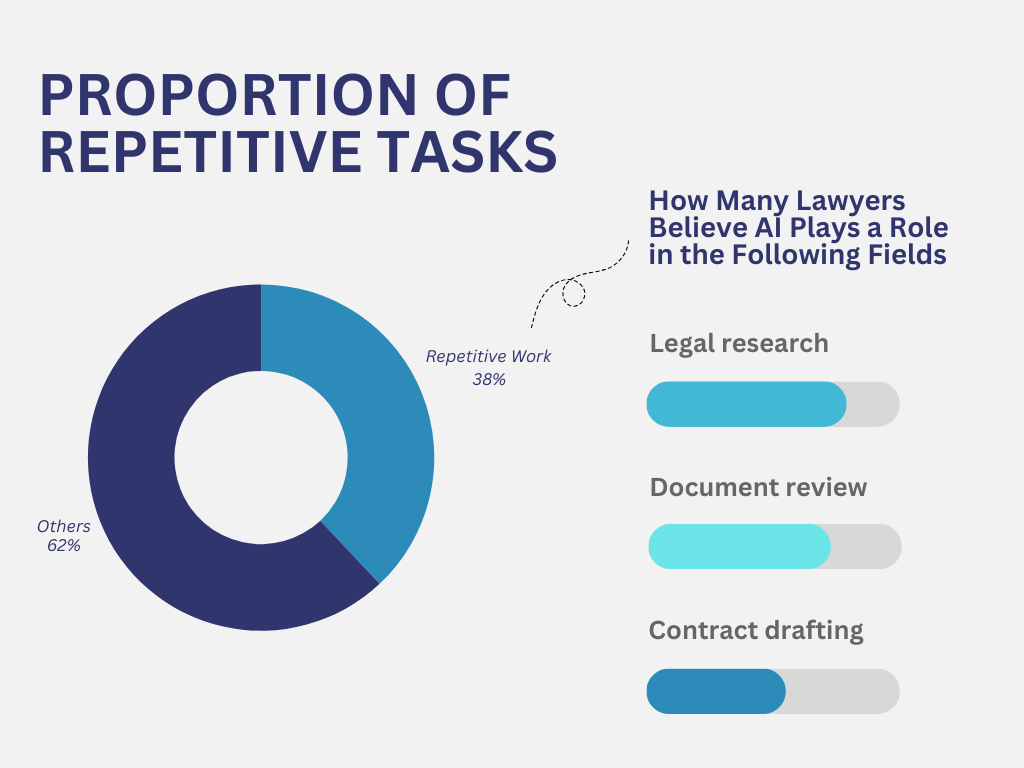
Service intelligence driven by legal technology is changing the nature of traditional legal work, with tasks such as automated document review and contract analysis freeing up attorneys’ time to focus on more complex and strategic work. This shift requires legal professionals to adapt to new ways of working and develop the ability to collaborate with AI. The report notes that about 38% of tasks in a lawyer’s job are routine and repetitive, and that these tasks can be improved through using AI. The results of this section of the survey indicate that lawyers generally believe that AI can be useful in tasks such as legal research (79.7%), document review (72.1%) and contract drafting (55.8%). What these tasks have in common is that they all involve a lot of information processing and pattern recognition, which is what AI technology excels at. But it’s also important to be mindful of legal compliance in its use, as Andrew Scott Bell, Chief Justice of the Supreme Court of New South Wales, released a guideline for the use of generative AI in legal practice last year. (For more information, click on the link to the previous post Artificial Intelligence + Law: New South Wales, Australia, Regulates AI Technology Use in Legal Practice—Embracing the Future or Setting Limits?).
This image is an original creation by the author based on relevant data and materials. The copyright belongs to Sunfield Chambers Solicitors & Associates. Unauthorized reproduction, modification, or commercial use in any form is prohibited. For reprinting, please cite the source and contact marketing@schambers.com.au for permission.
In addition, technology-driven online platform legal software offers more possibilities for cross-border legal services. Legora, for example, provides global databases to help lawyers understand the laws and regulations of different regions, assisting them in reviewing searches and drafting documents. In order to cope with the market landscape brought about by the proliferation of cross-border services, it requires traditional law firms to adapt to the development of technology as soon as possible, and rationally utilize innovative technologies to improve the quality of services. Such cross-border legal services can not only meet the growing internationalization needs of clients but also enhance the level and competitiveness of law firms in the field of international legal services.
Sunfield Chambers Solicitors & Associates, as a traditional law firm, has a positive and open attitude towards the use of AI and will continue to focus on the integration of the legal industry and innovative technologies. This is the second post in our AI series focusing on the intersection of the legal industry and AI technology. We sincerely invite you to join the discussion, share your insights, and explore with us the future picture of legal services.
Writer: Xueying(Grace) Yang Content Planner: Yan Zhou Yan Zhou; Xueying(Grace) Yang Proofreading: Gang(Abraham) Sun
This article only represents the author’s personal views and is intended to share insights into the business models of legal technology companies and traditional law firms. It is based on publicly available information and the author’s understanding, and does not constitute any form of professional legal advice or business decision. Readers should refer to this article in light of their own actual situation and consult relevant professionals for specific guidance. The author and the publishing platform assume no legal responsibility for any consequences arising from the use of the information in this article.
Latest Posts:
- Privacy Challenges in the AI Era: Is Your Information Truly Secure?
- 5% Deposit Scheme Explained: New Opportunities for First Home Buyers
- Zong Fuli Steps Down: The Succession Challenge for Private Enterprises
- “I want a divorce, but he’s in prison overseas” – Wang Nuannuan’s cross-border divorce dilemma
- What is International Public Notary? A Practical Guide for Seamless Cross-Border Document Circulation