



With the continuous improvement of global transportation infrastructure, cross-border e-commerce has experienced rapid growth. In recent years, the share of Chinese sellers in the global cross-border e-commerce market has been steadily increasing. Between 2012 and 2016 alone, China’s cross-border e-commerce market expanded from 293.7 billion RMB to 1.28 trillion RMB. This rapid development is not only driven by growing market demand but also closely related to policies such as the establishment of free trade zones and the promotion of the Belt and Road Initiative by the Chinese Government, which have created a more favourable environment for international trade.
Leading cross-border e-commerce platforms such as Amazon, eBay, and Shopee have become key channels for Chinese businesses expanding overseas. These platforms have relatively low entry barriers, allowing individuals and small businesses to participate in international trade. However, many sellers, lacking legal knowledge and professional support, often overlook intellectual property compliance issues. Intellectual property is a crucial business asset, yet it is frequently underestimated. As a result, lawsuits against Chinese cross-border e-commerce sellers have significantly increased in recent years. For instance, in 2020, a U.S.-based intellectual property law firm specializing in international intellectual property protection filed 243 lawsuits against Chinese sellers, leading to the closure of 22,000 seller accounts and the shutdown of 5,900 websites, causing severe disruptions to many sellers’ business operations.
Therefore, the rise of cross-border e-commerce presents both opportunities and increasing challenges in intellectual property compliance. Many countries are strengthening their intellectual property policy, and cross-border e-commerce platforms are simultaneously tightening compliance standards, reducing the survival space for non-compliant sellers. To navigate this evolving landscape, sellers must enhance their awareness of intellectual property compliance to mitigate legal risks and ensure sustainable business growth. This article will analyze common forms of intellectual property infringement in cross-border e-commerce, explore current compliance requirements, and provide practical guidance for compliant operations.
4 Common Types of Intellectual Property and Infringement Risks in Cross-Border E-Commerce

This image is an original creation by the author based on relevant data and materials. The copyright belongs to Sunfield Chambers Solicitors & Associates. Unauthorized reproduction, modification, or commercial use in any form is prohibited. For reprinting, please cite the source and contact marketing@schambers.com.au for permission.
- Trademark
Trademarks serve to identify and distinguish the source of goods or services and typically consist of text, graphics, or a combination of both. In cross-border e-commerce, trademark infringement risks are particularly prominent. On the one hand, if sellers fail to register their trademarks in target markets, it may result in their brand names or logos being pre-emptively registered by others, restricting their ability to operate under their own brand. On the other hand, unauthorized use of well-known trademarks or adopting similar names and logos by some sellers may cause market confusion, leading to infringement claims.
- Patent
Patent grant inventors exclusive rights to their innovations for a specified period. In cross-border e-commerce, patent infringement occurs when sellers manufacture, distribute, or sell patented products without authorization. Given that patent classifications and regulations vary across countries, businesses entering new markets must conduct thorough patent searches and intellectual property classification reviews to avoid legal conflicts.
- Copyright
Copyright typically refers to the exclusive rights of original content created by authors/brands, including product descriptions, images, videos, and advertisements, etc. Unauthorized use of copyrighted materials is a common issue in e-commerce. For example, some sellers may copy product images or modify copyrighted content without permission for their own product promotion pages, which can lead to complaints from copyright owners and penalties from e-commerce platforms.
- Trade Secrets
Trade secrets refer to information which has commercial value and is not publicly disclosed by enterprises, such as supply chain management details, manufacturing technologies, and marketing strategies. Intellectual property leakage is a significant risk in cross-border e-commerce, particularly given the involvement of multiple international trade partners. The unauthorized disclosure of trade secrets can directly impact a company’s competitiveness.
Import Regulations for Cross-Border Goods
As intellectual property infringement cases continue to rise in recent years, governments worldwide are increasing enforcement efforts. The United States, Australia, and South Korea have intensified their oversight of patent and trademark violations.
- United States: The U.S. Customs and Border Protection (CBP) has intensified its efforts to seize counterfeit and infringing goods. Registered trademarks and copyrights enable CBP to detain, confiscate, and, in most cases, destroy infringing items. According to annual data provided by U.S. Customs, from FY 2020 to FY 2024, the number of intellectual property-related seizures doubled, with the manufacturer’s suggested retail price (MSRP) of seized goods increasing by 415%. Notably, Mainland China and Hong Kong, China account for approximately 90% of all seized goods, highlighting the prevalence of intellectual property infringement in Chinese cross-border e-commerce exports.
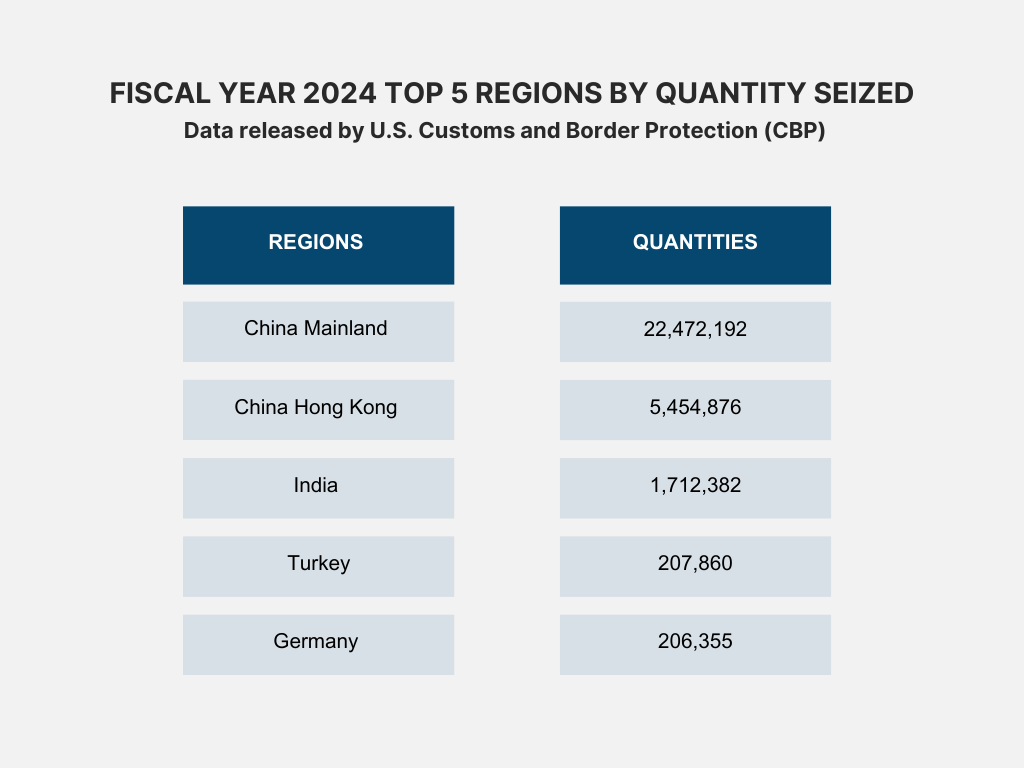
This image is an original creation by the author based on relevant data and materials. The copyright belongs to Sunfield Chambers Solicitors & Associates. Unauthorized reproduction, modification, or commercial use in any form is prohibited. For reprinting, please cite the source and contact marketing@schambers.com.au for permission.
- Australia: IP Australia is Australia’s leading administrative authority for rights affirmation. IP Australia works with the World Intellectual Property Organization (WIPO) and other international bodies to strengthen the global intellectual property (IP) rights system. Through a number of agreements and treaties, they actively participate in and promote the international management of intellectual property. In 2008, IP Australia established the Patent Examination Centre in Melbourne, which aims to increase the number of examiners and share the workload of existing examination bodies, thereby reducing patent examination time and improving examination efficiency.
- South Korea: The National Assembly recently passed a partial amendment to the Unfair Competition Prevention and Trade Secret Protection Act during a plenary session, increasing punitive damages for willful intellectual property infringement from three times to five times the original damages amount. This reform underscores South Korea’s commitment to stricter enforcement of intellectual property law.
Intellectual Property Protection Initiatives on Cross-Border E-Commerce Platforms
To combat intellectual property leakage, cross-border e-commerce platforms have strengthened their Intellectual Property protection measures. Cases of products being taken down or accounts being banned due to infringement complaints have become more common. Major platforms have strengthened their intellectual property complaint mechanisms, making it easier for infringing products to be removed, and violating sellers may even face the risk of account suspension.
- eBay: To maintain platform order and protect the rights of intellectual property owners, eBay launched the VeRO (Verified eBay Rights Owner) program. The program allows trademark and copyright owners to report infringing listings, ensuring unauthorized products are promptly removed.
- Amazon: The Brand Registry program requires sellers to provide trademark registration certificates to receive platform protection. The program also includes an automated predictive tool that identifies potential intellectual property risks, reducing unnecessary complaints and violations.
- Shopee: The Seller Education Hub includes a Brand Intellectual Property Protection course, helping sellers recognize different types of intellectual property infringement, understand penalty rules, and report violations to protect their legitimate rights.
Overall, cross-border e-commerce platforms are continuously strengthening intellectual property protection measures. Sellers need to raise their awareness of compliance during their operations to ensure their products meet platform regulations and avoid the business risks associated with infringement.
Compliance Recommendations
- Increase Awareness of Intellectual Property Protection
Currently, many cross-border e-commerce sellers in China generally lack awareness of intellectual property protection, resulting in the frequent appearance of similar products in the market. Understanding intellectual property policy is not only about avoiding legal risks but also about safeguarding one’s own brand. Proactive intellectual property protection strategies can provide businesses with a competitive advantage in cross-border e-commerce.
- Recognize the Regional Nature of Intellectual Property Protection
Although international trade agreements have harmonized some aspects of intellectual property policy, significant differences still exist between countries. Protection duration, enforcement mechanisms, and classification standards vary, making it essential for sellers to tailor their strategies for different markets. These regional characteristics at the institutional level are one of the important sources of intellectual property risks in cross-border e-commerce.
- Monitor Intellectual Property Policies in Target Markets
To maintain brand legitimacy in global markets, sellers should continuously track intellectual property policy updates and trademark registrations. For example, IP Australia recommends using the Global Brand Database, which contains trademark records from over 70 countries and international organizations, helping sellers identify potential trademark conflicts in a timely manner.
Conclusion
Whether it is cross-border e-commerce or enterprises in other industries going overseas, they need to attach great importance to the avoidance of intellectual property risks. Expanding the international market is not only an extension of business, but also a global game of intellectual property. For enterprises, the protection of intellectual property rights is the core competitiveness to protect the future. As countries become more stringent in the protection of intellectual property rights, it is imperative for Chinese companies to adopt a proactive defensive strategy and seek professional legal support in a timely manner.
As a Chinese-led international law firm, Sunfield Chambers Solicitors & Associates relies on its linguistic and cultural advantages to tailor solutions for enterprises to effectively avoid commercial difficulties caused by infringement complaints. Enterprises should strengthen the intellectual property risk investigation and early warning mechanism, actively respond to potential disputes, and lay the foundation for the sustainable development of themselves and the industry.
Writer: Xueying(Grace) Yang Content Planner: Yan Zhou Yan Zhou; Xueying(Grace) Yang Proofreading: Gang(Abraham) Sun
This article only represents the author’s personal views and is intended to share insights into the intellectual property protection in cross-border e-commerce. It is based on publicly available information and the author’s understanding, and does not constitute any form of professional legal advice or business decision. Readers should refer to this article in light of their own actual situation and consult relevant professionals for specific guidance. The author and the publishing platform assume no legal responsibility for any consequences arising from the use of the information in this article.
Latest Posts:
- Privacy Challenges in the AI Era: Is Your Information Truly Secure?
- 5% Deposit Scheme Explained: New Opportunities for First Home Buyers
- Zong Fuli Steps Down: The Succession Challenge for Private Enterprises
- “I want a divorce, but he’s in prison overseas” – Wang Nuannuan’s cross-border divorce dilemma
- What is International Public Notary? A Practical Guide for Seamless Cross-Border Document Circulation