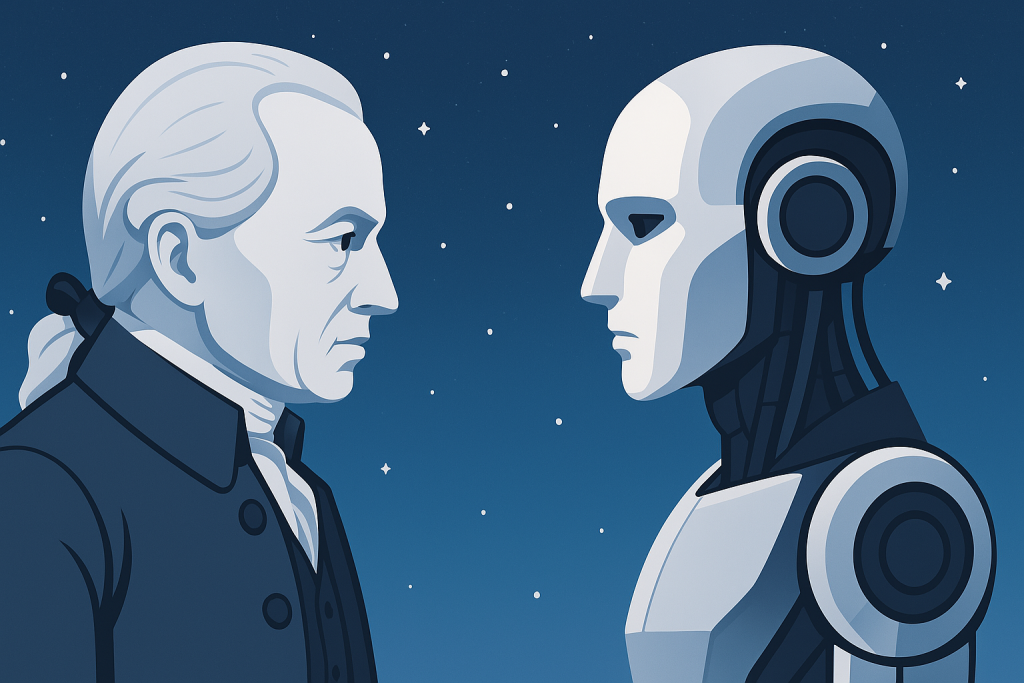
Two things awe me most, the starry sky above me and the moral law within me.
The German philosopher Immanuel Kant has left such a widely quoted sentence: “Two things awe me most, the starry sky above me and the moral law within me.” The “starry sky above my head” represents the operation of the laws of nature, the kind of ‘inevitability’ that is not subject to human will; while the “moral law in my heart” is about free will, the human being’s internal judgment of “what should be done”. The se two seem to be in opposition, but in Kant’s view, they both derive from the rationality of human beings. We are human precisely because we can both understand the rules of nature and discipline ourselves in reason.
Today, this statement has a new context of reality. With the development of artificial intelligence, we begin to try to outsource “rationality” to algorithms, allowing AI to make judgments and even decisions in specific scenarios. The question arises: AI can process information efficiently, but can it have “moral laws” like humans? Does it make decisions that take into account “should” rather than just “could”? If its choices involve ethics, or even violate the law, how will it be held accountable?
Kant's Moral Law
In Kant’s view, a truly moral action is not motivated by fear of punishment or profitability, but by one’s realization that “I ought to do this” and one’s willingness to act in accordance with that “ought”. He put forward a very famous concept – “categorical imperative”. Simply put, it’s a moral test: if what you do can be generalized as a universal law that all people should do, then it’s moral; if it can’t be generalized, then it’s immoral. For example, if you think that “lying is okay,” then ask yourself this question: if everyone in the world lied, would society be able to function properly? If the answer is no, then lying cannot be a moral behavior.
This moral standard may seem idealistic, but its appeal lies in setting a rational and universal “high standard” for human behavior. It does not depend on external authority, but comes from inner self-legislation. This moral law, based on reason, is not just an object of philosophical discussion; it has profoundly influenced modern ethics and has even laid the value foundations for many legal systems.
Artificial Intelligence and the Moral Law: what raises concerns?
The rapid rise of artificial intelligence has brought us many technological dividends – automatic driving, voice recognition, intelligent assistants ……AI seems to be omnipotent. However, when AI is not only a tool, but also “making choices” and “making judgments” in certain situations, a troubling question emerges: are its decisions ethical?
AI is good at integrating and processing data, but may not understand “why” a decision should be made. In moral judgment, human choices are often based not on algorithmic optimization, but on a sense of responsibility and respect for others. The “moral dilemma” of autonomous driving is a classic example: if a self-driving car has to “choose” whether to harm one or more people in an inevitable accident, how should it decide? Human drivers faced with such a situation often rely on split-second intuition, the result of a combination of emotion and moral responsibility. The AI’s “decision-making” is based on programming and data evaluation; is the AI just executing a program, or is it understanding responsibility? Does it internalize moral rules rather than merely simulate them? These questions may seem abstract, but they are becoming real legal challenges.
Legal Issues in AI Ethical Dilemmas
The ambiguity of AI’s moral judgments directly raises legal challenges in reality. When AI “decisions” have consequences, especially when they cause harm, the legal system must answer several key questions: how is responsibility defined? Can ethical standards be translated into legal norms? Are existing laws adequate to meet the challenges posed by AI?
1.Attribution of responsibility
When AI causes real damage, who should bear the responsibility? Current legal practice mostly attributes responsibility to the human behind the AI – the developer, operator or user. However, the problem is that the behavior of AI is often characterized by a “black box”, with complex and untraceable decision-making logic. It does not simply carry out orders, but makes judgments in continuous learning and self-adjustment. This makes the determination of the “causal chain” vague. For example, if an AI legal assistant provides wrong advice, which directly leads to the loss of the client, is the responsibility a problem of the algorithm model? A bias in the training data? Or is it the user’s improper use? This kind of responsibility allocation issue is becoming a difficult problem that the legal system must face.
2.Transformation of ethical standards
AI systems make decisions by “learning” from historical data, but this data often carries social issues such as prejudice, discrimination and stereotyping, which can be amplified or even institutionalized through AI algorithms. For example, when AI is used to assist in judicial decision-making, based on historical case data, it may unfairly assess the risk of prejudice against a particular gender, ethnic group, or class of people. In this case, the so-called “technological neutrality” actually hides deep-seated inequalities. Therefore, the “fairness” of algorithms should be a central issue for the legal system to scrutinize. How to translate the ethical concepts of “fairness”, ‘transparency’ and “non-discrimination” into practicable legal provisions is a great challenge.
3.Adaptation of the existing legal framework
With the rapid development of AI technology, existing legal frameworks are lagging behind, ambiguous or insufficiently adapted to meet the challenges posed by the emerging technology. To address this challenge, many countries and regions have accelerated their legislative processes, with the European Union taking the lead with the world’s first comprehensive EU AI Act, which categorizes certain AI systems as “high-risk” and requires them to be transparent, explainable, and subject to human oversight. However, the legislation still faces a number of challenges: will legal restrictions hinder technological innovation? How to balance the need for regulation with the need for innovation to avoid over-regulation or stifling industry growth? These questions have prompted the legal profession to rethink how to integrate ethical principles not only in theoretical discussions, but also into the legal system, enforcement and market rules, to ensure that AI technologies can continue to develop healthily within a legally compliant framework.
Future Prospects: the moral law of AI, can it be constructed?
Looking towards the future, the development of AI technology not only challenges the legal system, but also asks questions about the bottom line of values in human society. Kant once pointed out that the moral law exists in the human heart and is a universal norm given to individuals by reason. Nowadays, when AI gradually participates in decision-making and influences human life, we may not be able to give AI a real moral consciousness, but we can think about this: can we build a kind of “external rationality” through the law, and embed the value principles of fairness, respect, and responsibility into its technological logic? We are witnessing a wide-ranging exploration of “AI codes of conduct”, from the technical compliance mechanisms of enterprises to the ongoing attention of the legal academia. In the future, the “morality” of AI systems may no longer rely solely on human preconceived judgments, but will gradually form a new type of order based on rules, negotiation, and a sense of responsibility. The law will go beyond a single normative tool in this process, and become the guardian and transmitter of human values, so that the development of technology always centers around human dignity. In this way, AI can truly become a tool in the service of reason, freedom, and justice, responding to Kant’s quest for an ideal world of “starry skies and inner law. ”Sunfield Chambers Solicitors & Associates has always been engaged in the intersection of AI and law, and we welcome the dialog and challenges that these challenges present. We welcome the dialog and collision that these challenges bring, and believe that rationality, openness, and compatibility are the key forces that will drive the development of AI for the better. If you have any questions about the application of AI, ethical issues, privacy protection or the definition of legal responsibility, or wish to have an in-depth exchange with us on these cutting-edge issues, we sincerely welcome your discussion.
Written by Xueying Yang; Content planning: Zhou Yan; Xueying Yang; Proofreading: Sun Gang
The content of this article is based on publicly available information and the author’s understanding, and does not constitute any form of professional legal advice or basis for business decisions. Readers should refer to this article in the context of their own actual situation and consult relevant professionals for specific guidance. The author and the publishing platform do not assume legal responsibility for any consequences arising from the use of the information in this article.
Consultation with Specialized Lawyers

Abraham Sun
Principal Solicitor
As the Principal Solicitor, Abraham has been working with numerous clients including listed companies, state-owned enterprises, ultra-high-net-worth clients, and investment banks. Customers in various industries including Australian and Chinese companies and individual investors, had achieved considerable economic benefits with his professional legal advice.

Annette Leung
Partner, Solicitor, Notary Public
Annette is an experienced lawyer who works with clients in a wide range of commercial and civil disputes, with a particular focus on marriage and family affairs. Also, her experience extends to assisting clients in other common law countries.

Amy Zhu
Partner, Senior Licensed Conveyancer
Amy is an experienced licensed conveyancer with years of experience in conveyancing matters. She has outstanding work experience and achievements in conveyancing services under property law and conveyancing law provisions. She is skilled in working with clients in Mandarin and English.

Ming Zhao
Partner, Solicitor, Senior Registered Migration Agent
Ming is proficient in migration law and has over 20 years of experience in migration applications. He specializes in business investment migration, employer nomination migration, employer nomination immigrantion in regional areas, working visa, partner migration, parent migration, etc.
Latest Posts:
- Privacy Challenges in the AI Era: Is Your Information Truly Secure?
- 5% Deposit Scheme Explained: New Opportunities for First Home Buyers
- Zong Fuli Steps Down: The Succession Challenge for Private Enterprises
- “I want a divorce, but he’s in prison overseas” – Wang Nuannuan’s cross-border divorce dilemma
- What is International Public Notary? A Practical Guide for Seamless Cross-Border Document Circulation
- Experiencing Domestic Violence or Harassment? Criminal Lawyers Show You How to Effectively Use AVO to Respond

