


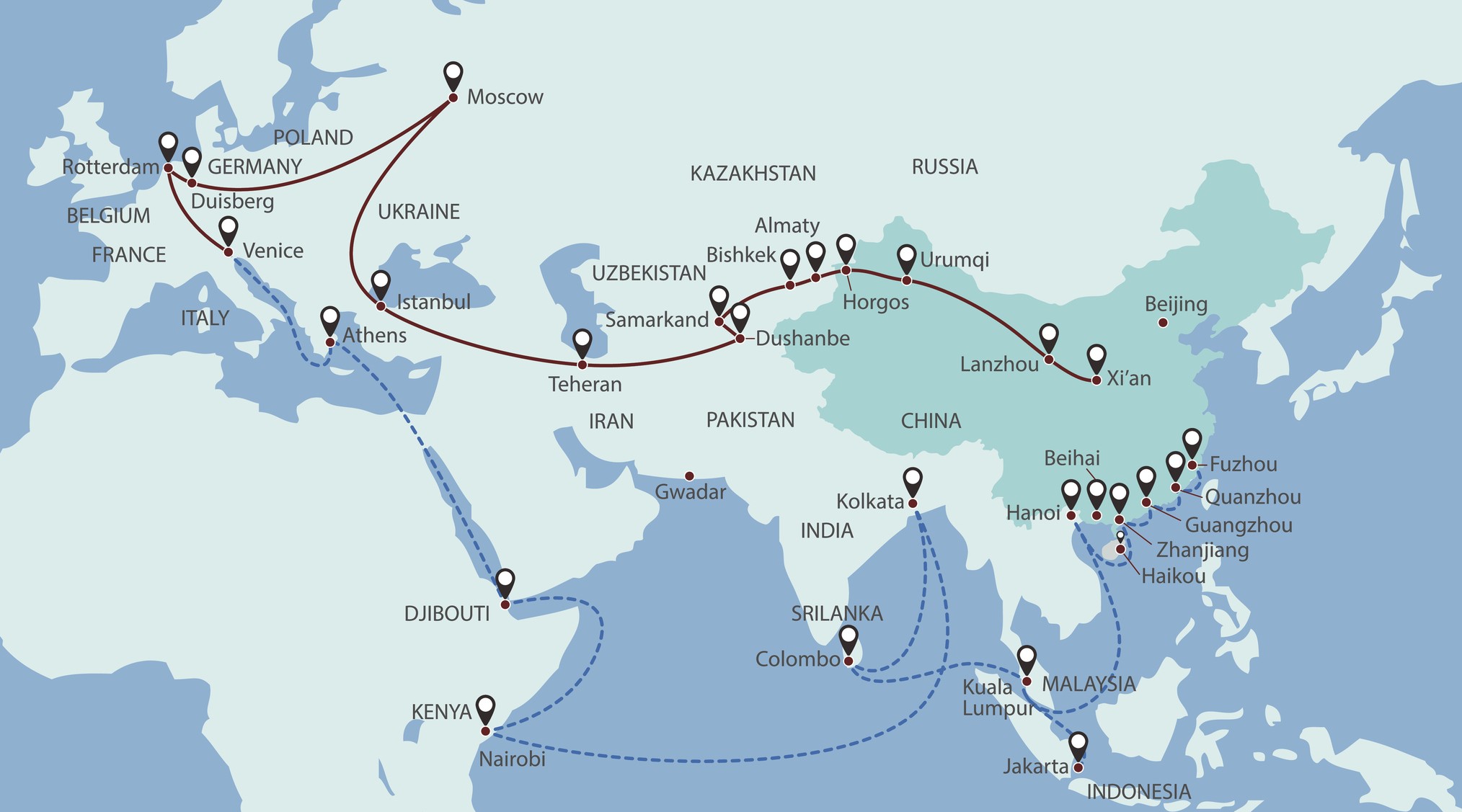
Since it was proposed in 2013, the Belt and Road Initiative has gone from concept to action, from vision to reality, connecting Asia, Europe, Africa and other regions, covering more than 150 countries and more than 30 international organizations. For Chinese enterprises, this not only means more markets and a wider stage, but also new opportunities to participate in global competition and build international brands.
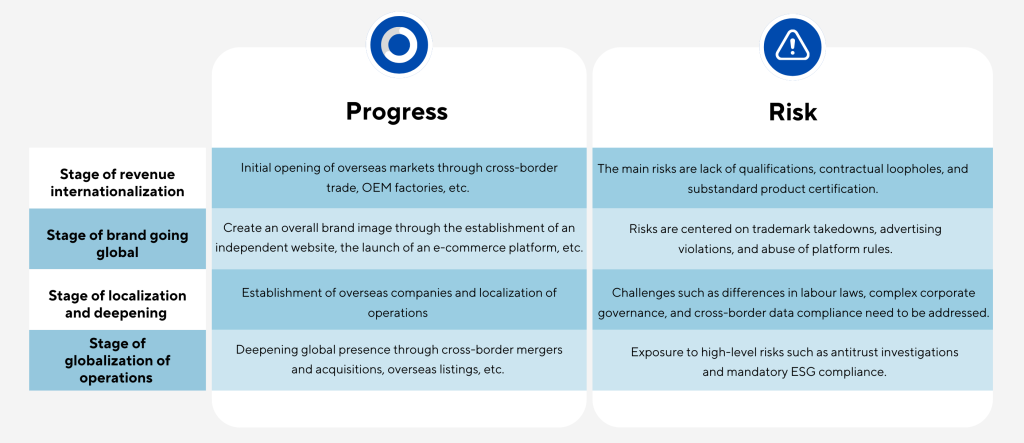
With the continuous promotion of the “Belt and Road” initiative, the pace of Chinese enterprises going overseas has been accelerating. According to the latest report, there are four clear stages of development for Chinese companies going overseas: revenue internationalization, brand globalization, deep localization and globalized operation. Each stage is accompanied by its own unique and complex legal challenges. From the initial stage of opening up overseas markets through commodity exports, to the subsequent stage of brand globalization, to the establishment of overseas companies to realize localized operations, and ultimately the strategic layout of the global market, legal issues have been present throughout the entire process, and the types of risks have become more and more complex and variable with the advancement of the stages.
Specifically, at the stage of revenue internationalization, enterprises mainly face risks such as lack of qualification, contract loopholes, and substandard product certification. In the branding stage, trademark squatting, advertising violations, and abuse of e-commerce platform rules become new legal risks. As companies set up subsidiaries overseas and promote localized operations, labour law differences, corporate governance complexities, and cross-border data compliance issues are becoming more prominent. Antitrust investigations and mandatory environmental, social and governance (ESG) compliance are significant legal risks that companies cannot avoid during the globalization phase. While these risks can be categorized according to the stage of development, in practice, companies often encounter overlapping legal challenges at different stages, making the overall risk map more complex and intertwined.
This image is an original creation by the author based on relevant data and materials. The copyright belongs to Sunfield Chambers Solicitors & Associates. Unauthorized reproduction, modification, or commercial use in any form is prohibited. For reprinting, please cite the source and contact marketing@schambers.com.au for permission.
1. Compliance and Regulatory Conflicts
In the process of actual overseas operation, the legal pain points faced by enterprises far exceed the stage-by-stage risk summary, mainly reflected in compliance and regulatory conflicts and obstacles brought by differences in laws of various countries. Due to the vastly different legal systems and enforcement standards of various countries, enterprises frequently encounter difficulties in market access, environmental requirements, audit rules, etc. Some countries have lengthy environmental approval processes. In some countries, the environmental protection approval process is lengthy and not transparent enough, which directly affects project promotion; some emerging markets have strict investment restrictions on foreign investment and require additional licenses; and the lack of clarity on the applicable laws and dispute resolution mechanisms in the contractual terms and conditions also leads to implementation difficulties. For example, in emerging markets such as Southeast Asia, local enterprises hold a natural exclusionary mentality toward foreign investment, and in the future there may be more access thresholds for Chinese goods such as customs, logistics, and setting up factories. In mature markets such as Europe and the United States, the challenges faced by overseas enterprises are reflected in the extreme requirements for compliance details, which can easily lead to high penalties once ignored.
2. Labour and Employment Disputes
Secondly, labour and employment disputes have also become an issue of great concern for overseas enterprises. Due to the different labour law systems in different countries, enterprises face a lot of challenges in recruitment, labour management, working hours and termination of labour relations. In France, the layoff procedure is extremely complicated and requires strict social selection criteria; if the procedure is not compliant, enterprises will easily face high compensation or reinstatement judgment, resulting in labour risks; in Indonesia, the special policy of foreign employee quota also reflects the concrete manifestation of cultural differences and systemic barriers in the field of labour management. Risks in the field of labour and employment not only involve legal compliance, but also directly affect the normal operation and reputation of enterprises.
3. Different pain points in different industries
In addition, different industries face different legal pain points in the process of going overseas. For example, manufacturing companies are most concerned about compliance reviews, especially product certification, supply chain transparency, etc. Failure to meet standards not only affects market access, but may also lead to subsequent claims. Technology companies are highly concerned about data protection, and in the face of increasingly stringent cross-border data flow and privacy rules in various countries, they must invest a lot of resources to ensure compliance, or else they are very likely to be penalized or restricted from business expansion. The cross-border e-commerce industry’s pain points are centered on intellectual property protection and abuse of platform rules, with some sellers losing the initiative in the market due to their brands being seized by overseas competitors. Meanwhile, on e-commerce platforms such as Amazon and eBay, it is not uncommon to see a company blocked for minor violations and the payment for goods frozen, which has greatly increased operational uncertainty. These industry-specific legal challenges not only exacerbate the difficulty of risk management in the process of going overseas, but also put forward higher requirements for enterprises’ compliance ability and forward-looking layout.
– Pre-planning
In response to the above challenges, enterprises must adopt a systematic legal response strategy in the process of going overseas. First of all, in the preliminary planning stage, it is important to carry out comprehensive due diligence on the legal environment and fully understand the entry thresholds, investment restrictions and environmental compliance requirements of the target markets. At the same time, we should reasonably design the terms of the trade contract, specify the applicable laws, dispute resolution mechanism and place of execution, and give priority to arbitration rather than litigation, so as to optimize the convenience of dispute resolution in the future. It is especially emphasized that legal and compliance risk management must be front-loaded, and enterprises need to integrate legal considerations into business strategies, business models and R&D designs, so as to truly synchronize with the overall layout of the enterprise.
– Operation Stage
In the operation stage, enterprises should lay out intellectual property protection in advance and synchronize the registration of trademarks and patents globally, so as to avoid losses due to brand damage. At the same time, they should strengthen data compliance and labour compliance management to ensure smooth localized operations and reduce the risk of penalties due to labour disputes and data violations. In this process, the “common sense” of local lawyers is often the “blind spot” of Chinese enterprises. Therefore, a team of professional lawyers with international vision and familiar with the characteristics of Chinese enterprises will become the important reliance of overseas enterprises to help them identify and avoid potential legal risks.
– Response Stage
Entering the Dispute Prevention and Response Stage, enterprises need to establish a professional cross-border dispute resolution mechanism to respond quickly to all kinds of cross-border commercial disputes. International arbitration has become the preferred route for cross-border dispute resolution due to its neutrality, professionalism and enforceability of awards. Compared with litigation in overseas courts, international arbitration can effectively reduce the risk of non-transparent procedures and inconsistent standards. At the same time, the global enforceability of arbitral awards also guarantees that enterprises can truly realize their rights and remedies in international investment. In cross-border business, complex and changing legal environment is inevitable, only through professional and systematic dispute prevention and response mechanism, enterprises can walk steadily on the road of globalization.
Against the backdrop of the deepening of the “Belt and Road” initiative, Chinese enterprises are accelerating their pace of “going out” and are facing more diverse and complex cross-border legal risks. Challenges encountered by enterprises at different stages of development vary, covering multiple dimensions such as market access, regulatory compliance, data flow, labour and employment, and dispute resolution. Only by integrating legal compliance into the overall strategy can enterprises advance their global layout in a steady manner. Relying on our rich cross-border legal practice experience and professional international arbitration capability, Sunfield Chambers Solicitors & Associates will assist our clients in effectively controlling risks and smoothly resolving disputes in the midst of changing circumstances, as well as winning the initiative and the first opportunity in the process of globalization.
Written by Xueying Yang; Content planning: Zhou Yan; Xueying Yang; Proofreading: Sun Gang
The content of this article is based on publicly available information and the author’s understanding, and does not constitute any form of professional legal advice or basis for business decisions. Readers should refer to this article in the context of their own actual situation and consult relevant professionals for specific guidance. The author and the publishing platform do not assume legal responsibility for any consequences arising from the use of the information in this article.
Consultation with Specialized Lawyers

Abraham Sun
Principal Solicitor
As the Principal Solicitor, Abraham has been working with numerous clients including listed companies, state-owned enterprises, ultra-high-net-worth clients, and investment banks. Customers in various industries including Australian and Chinese companies and individual investors, had achieved considerable economic benefits with his professional legal advice.

Dickson Luo
Solicitor
Dickson mainly conducts dispute resolutions and commercial litigation in areas across insolvency, corporations, employment, real property and consumer law. He is proficient in English and Chinese Mandarin, and have extensive experience acting for clients who have limited or no English skills in complex disputes and litigation matters.

Linda Thai
Solicitor
Linda assisted our legal team with a range of litigation matters in Australian intermediate and superior courts. She has established solid foundations in litigation from assisting in matters from the initial investigation stage to briefing and liaising with barristers and also assisting our solicitors at court appearances.

Bhanu Seemar
Solicitor
Bhanu is a commercial litigation lawyer who has extensive experience working closely with counsel on a range of commercial law matters including contract disputes, insolvency disputes, consumer and franchise disputes, shareholder claims, financial services and regulatory enforcement matters, corporations law, and class action litigation.
Latest Posts:
- Privacy Challenges in the AI Era: Is Your Information Truly Secure?
- 5% Deposit Scheme Explained: New Opportunities for First Home Buyers
- Zong Fuli Steps Down: The Succession Challenge for Private Enterprises
- “I want a divorce, but he’s in prison overseas” – Wang Nuannuan’s cross-border divorce dilemma
- What is International Public Notary? A Practical Guide for Seamless Cross-Border Document Circulation
- Experiencing Domestic Violence or Harassment? Criminal Lawyers Show You How to Effectively Use AVO to Respond