Last week, a shocking video was widely circulated on social media of a Chinese couple being attacked by several teenagers for no apparent reason in Sydney’s Eastgardens residential area, leaving them not only physically injured, but also psychologically traumatized in a way that will be difficult to heal. All of the minors charged have been granted conditional bail and are expected to appear in the Children’s Court in June. Police also confirmed that the search for the other persons involved in the incident has been terminated. In the aftermath of the incident, a number of victims reported that they had been previously harassed and assaulted by the same group of youths, suggesting that this is not an isolated incident but may have deeper structural social problems.
Even more worrying is the fact that after the incident came to light, there have been reports of Chinese being viciously attacked by teenagers in areas such as Haymarket and Zetland in central Sydney. The frequency of violence is on the rise and is likely to escalate further if not curbed soon. This incident not only unveils the cracks in community policing, but also exposes a truth that cannot be ignored: when racism is no longer just about words and prejudice, but turns into fists and blood, what should we really do?
The Eastgardens incident is not an isolated case. Over the past few years, across Australia, from the streets to the school campuses, the Asian, and especially the Chinese community, has been repeatedly targeted by teenage violence and racial prejudice.
Why do these teenagers dare to commit violence repeatedly? The root cause lies in the loopholes in the current juvenile justice system: overly lenient disciplinary mechanisms that prevent recidivism from being effectively curbed; and legal protections for minors that, while well-intentioned, in some cases condone victimization of others.
At the same time, the stereotypes of the Asian community in society and the education system have not yet been eliminated. Subconscious prejudices such as “Chinese people are easy to bully and dare not resist” are often instilled invisibly when young people have not yet established sound values, and in the absence of multicultural education and anti-discrimination guidance, hostility quietly festers, eventually evolving into real violence.
Most importantly, many Chinese choose to remain silent after being subjected to violence: they don’t report it, don’t speak out, and don’t expose it, probably because they are afraid of problems with their identity, don’t want to get into trouble, and don’t trust the mechanism, among other reasons. However, it has been proven time and again that patience cannot be exchanged for respect, nor can avoidance solve the problem. In order to break the vicious circle, we must fundamentally change the way we react.
In Australia, Chinese people have always been regarded as a “model minority”: hard-working, law-abiding and trouble-free. But the reality is that individual effort alone does not translate into systemic respect and security. We need to understand that without political participation and without voicing our demands, our interests will never be prioritized.
It is gratifying to note that this time, the Chinese community has begun to break its silence and take the initiative to speak out:
– At the community level, people have spontaneously set up a “neighbourhood watch” mechanism to exchange safety information, share suspicious incidents in a timely manner, and form a preliminary self-protection network;
– At the action level, an online petition has collected tens of thousands of signatures in just a few days, calling on the state government to reform the juvenile justice system and increase penalties for violent crimes;
– At the self-defense level, there are instructors offering free self-defense classes on basic body protection and self-defense principles;
Although these efforts are still in the early stages, it shows that we have the ability to self-organize and unite our voices. The Chinese community is moving from a “silent majority” to a “active minority”, a step that is not easy but extremely important. It means that we are no longer mere bystanders, but are beginning to become participants in the public affairs of this land.
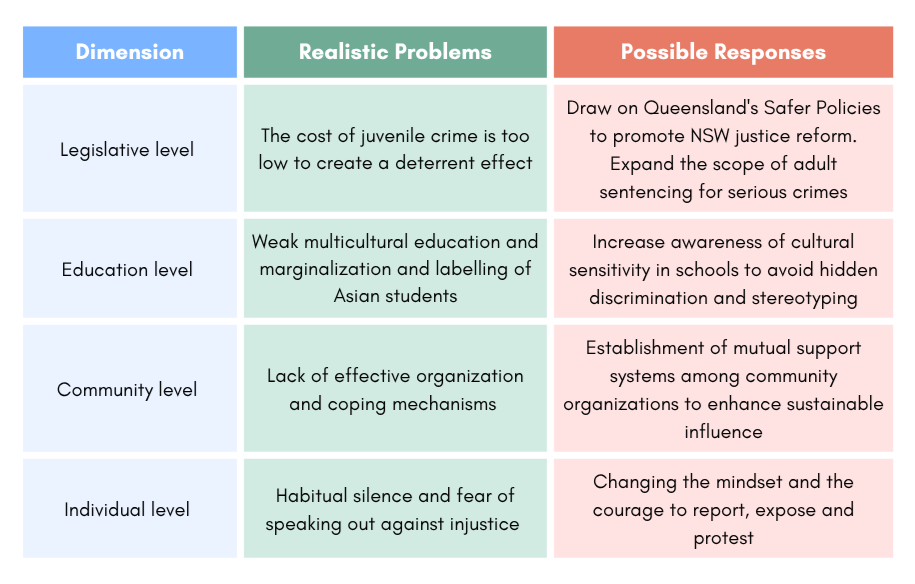
However, real change requires more than emotion and courage, and whether the Eastgardens incident will be a turning point depends on our ability to push through a series of practical, systemic-level reforms. What we need is not a short-term reactive response, but deep systemic change.
1. Legislation: reshaping the justice system
Currently, minor perpetrators of violence are often given lighter sentences or even exempted from custody through “protection mechanisms”, leaving the victim to continue to suffer from insecurity and fear until the justice process is complete. In contrast, Queensland’s Making Queensland Safer Act, introduced last year, has taken steps to raise the threshold of accountability for juvenile offenders and expand the application of adult criminal standards in serious cases. These institutional reforms are worthy of serious consideration and promotion in New South Wales.
2. Educational level: eliminating invisible discrimination
School is a key place for the formation of values. Incorporating multicultural understanding and anti-discrimination awareness into the systematic curriculum and providing correct guidance to young people in their early cognition is not only a responsibility of education, but also the first line of defense in preventing sexual violence. While explicit racial discrimination is now more controlled, implicit discrimination is still widespread – seemingly neutral labels such as “Asian students are quiet” and “Chinese people don’t complain” actually contribute to the marginalization of Asians and the rationalization of aggressive behaviour.
3. Community Level: Continuing to Expand Impact
In the face of continuing violence, some Chinese communities have begun to organize self-defense training, legal seminars, and psychological and legal support. However, if these actions lack systematic support and resources, it is often difficult to create a sustained impact. Law firms, public interest organizations, and media organizations should strengthen their cooperation and establish response mechanisms, such as a special assistance hotline.
While advocating for better social mechanisms, both individuals and groups can actively participate in public expression. By establishing contact with local legislators, the public can express their demands and make suggestions on specific incidents. For example, Member of the NSW Legislative Assembly Jason Yat-Sen LI, after the Eastgardens incident came to light, he made a statement at the first time and boycotted any discrimination or attack against us Chinese Australians.
4. At the individual level: changing ideologies
We may not be used to “standing up”, but times have changed. If the Chinese community continues to be the “silent majority”, it will be difficult to push for change even when there is injustice. Everyone should realize that reporting, exposing and participating in public events is not a way to cause trouble, but rather a legitimate defense of one’s legal rights.
At the same time, it is also important to raise awareness of personal safety. Being physically fit is not only a way of taking responsibility for yourself, but also a way of strengthening your ability to cope with emergencies.
Participating in self-defense sports not only helps to acquire practical skills, but also helps to enhance physical reflexes and self-confidence. Recommended programs include Judo ( such as OKO JUDO CLUB), Brazilian Jiu-Jitsu (such as Gracie Botany), Taekwondo (such as WEIWU TAEKWONDO), as well as Mixed Martial Arts (MMA), Karate, and Yong Chun, which can be tried out according to individual interests.
The Eastgardens incident reminds us once again that silence is not a solution to the problem, and that the Chinese community should no longer choose to back down and avoid challenges to public safety and community rights. As a legal services organization, Sunfield Chambers Solicitors & Associates always believes that the law should provide every law-abiding citizen with a true sense of security and dignity. We have reason to expect the law to give a clear and strong response to violent behaviour, and we also hope that the community can see that the Chinese are not a silent group, but a group that speaks out rationally and defends their rights in accordance with the law. Next time, what we would like to see is no longer a video of street violence, but justice landing in court.
Written by Xueying Yang; Content planning: Sun Gang; Xueying Yang; Proofreading: Sun Gang
The content of this article is based on publicly available information and the author’s understanding, and does not constitute any form of professional legal advice or basis for business decisions. Readers should refer to this article in the context of their own actual situation and consult relevant professionals for specific guidance. The author and the publishing platform do not assume legal responsibility for any consequences arising from the use of the information in this article.
Consultation with Specialized Lawyers

Abraham Sun
Principal Solicitor
As the Principal Solicitor, Abraham has been working with numerous clients including listed companies, state-owned enterprises, ultra-high-net-worth clients, and investment banks. Customers in various industries including Australian and Chinese companies and individual investors, had achieved considerable economic benefits with his professional legal advice.

Dickson Luo
Solicitor
Dickson mainly conducts dispute resolutions and commercial litigation in areas across insolvency, corporations, employment, real property and consumer law. He is proficient in English and Chinese Mandarin, and have extensive experience acting for clients who have limited or no English skills in complex disputes and litigation matters.

Ming Zhao
Partner, Solicitor
Ming is proficient in immigration law and has over 20 years of experience in this area of law. He specialises in business skills migration, employer nomination scheme, employer nomination migration in regional areas, etc. Also, Ming is highly experienced in all areas of criminal defence, including matters involving drink driving, drive while disqualified/suspended, etc.

David Ho
Solicitor
David’s main practice areas are criminal defence and immigration law. He assists client in defending criminal proceedings and assist with visa and/or citizenship applications. David is always dedicated irrespective of the complexity of the matters, and he is always diligent and practical.
Latest Posts:
- Privacy Challenges in the AI Era: Is Your Information Truly Secure?
- 5% Deposit Scheme Explained: New Opportunities for First Home Buyers
- Zong Fuli Steps Down: The Succession Challenge for Private Enterprises
- “I want a divorce, but he’s in prison overseas” – Wang Nuannuan’s cross-border divorce dilemma
- What is International Public Notary? A Practical Guide for Seamless Cross-Border Document Circulation
- Experiencing Domestic Violence or Harassment? Criminal Lawyers Show You How to Effectively Use AVO to Respond