
Blog

How Can Australian Businesses Respond to New Compliance Challenges Related to Cross-border Data Transfers? 

Article Navigation: 

  • Basic Requirements for Cross-border Data Regulation in Australia
  • Upgraded Regulation of Sensitive Information and Industry Risks
  • Key Steps for Corporate Compliance and Practical Recommendations


Global regulation of cross-border data flows continues to intensify, and companies are gradually realizing that data transfers abroad are no longer simply a matter of privacy protection, but rather an important issue involving trade secrets and technological sovereignty. 

For Chinese-owned enterprises and multinational companies operating in Australia, how to legally and compliantly transfer data (such as employee information, consumer data, technical information, etc.) back to their headquarters in China or other overseas locations within the Australian legal framework has become an unavoidable key issue. 

In Australia, data compliance is not just a matter for the IT department, but a legal requirement enshrined in law. As early as the last century, Australia enacted the Privacy Act 1988, which clearly outlines the responsibilities businesses must assume when collecting, using, storing, and transmitting personal information. Whether it’s for marketing, customer service, or managing internal employee information, any activity involving personal data must consider compliance with legal requirements. The core regulation governing data transfers out of Australia is the Australian Privacy Principles (APPs) under the Privacy Act 1988, which establish a compliance framework for cross-border data transfers. 

In recent years, “ data export” has become a key regulatory focus for many countries. Many companies, in pursuit of operational efficiency, upload local customers’ consumption records or behavioral data to overseas servers for subsequent business operations such as analysis models and user profiling—these may seem like routine technical processes, but if they lack clear notification, fail to obtain user consent, or cannot clearly control the flow of data, they may violate Australia’s privacy protection requirements. More importantly, once issues arise, it is not only trust that is damaged; relevant companies may also face investigations or penalties from regulatory authorities. 

What kind of information is protected by law? Simply put, there are two categories: 

🟦 General personal information: name, phone number, address, date of birth, bank card number, etc. 

🟥 Sensitive information: such as your race, health status, religious beliefs, sexual orientation, criminal record, etc. This type of information is subject to stricter protection. 

For businesses, data compliance is not just about “not leaking” information. You must also clearly inform customers why the information is being collected and how it will be used. Before using the information for marketing or analysis, you must first obtain the customer’s consent. Additionally, data must be properly stored to prevent loss, theft, or accidental transmission to third parties. Customers also have the right to access their information at any time and request corrections or deletions if they find any inaccuracies. If this information needs to be transferred overseas, such as shared with partners or headquarters teams, even greater caution is required—the transfer must comply with local Australian laws, and the process must be transparent. 

Australia’s definition of “sensitive personal information” is much broader than most companies imagine. According to privacy principles, sensitive data may include: 

  • Health and genetic information (such as facial images and medical records)
  • Biometric information (such as fingerprints and facial images)
  • Sexual orientation, religious beliefs, criminal records, etc.
  • Locational information and financial data that can identify individuals


As technology becomes increasingly integrated into daily operations, regulatory agencies are beginning to focus on “high-risk data usage scenarios” in specific industries. The following categories in particular require heightened vigilance: 

  • Automotive industry: After selling smart vehicles in Australia, many automakers upload remote diagnostic information and driving trajectories to overseas platforms. Such data often involves both owner identity and key technical parameters.
  • Pharmaceutical industry: Clinical trial data and patient health records are not only highly sensitive, but also often subject to overlapping regulatory requirements in multiple countries.
  • E-commerce retail: Features such as “AI makeup trials,” “facial recognition entry,” and “personalized recommendations,” which appear to enhance the user experience, often involve highly sensitive data such as users’ facial information and consumption habits. 

Last year, the Dutch data protection authority imposed a fine of €290 million on a globally renowned ride-hailing company (referred to as “U Company”). The reason was that U Company failed to properly handle drivers’ personal information in accordance with EU regulations and illegally transferred the data outside the EU. This fine is the highest penalty imposed for cross-border data transfers in 2024, attracting global attention and serving as a reminder to all companies involved in cross-border data transfers to prioritize compliance issues.   

Cross-border data flows have become one of the most frequently discussed issues in cross-border business operations. Whether it is transmitting user data back to headquarters or meeting operational requirements for global business coordination, multinational companies generally face complex compliance pressures when transferring data overseas. 

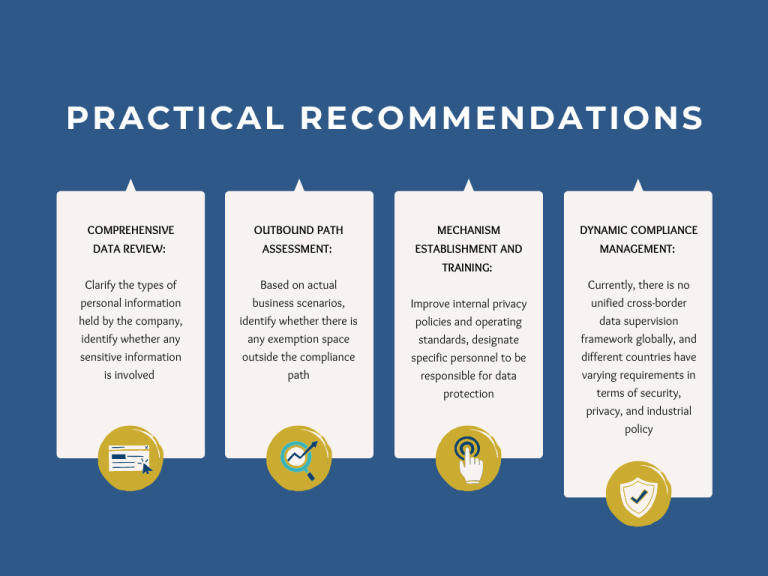
This image is an original creation by the author based on relevant data and materials. The copyright belongs to Sunfield Chambers Solicitors & Associates. Unauthorized reproduction, modification, or commercial use in any form is prohibited. For reprinting, please cite the source and contact marketing@schambers.com.au for permission.  

Comprehensive data review: Clarify the types of personal information held by the company, identify whether any sensitive information is involved, determine whether there is a genuine need to transfer data overseas, and avoid expanding the scope of compliance obligations due to “data redundancy.” 

Outbound path assessment: Based on actual business scenarios, identify whether there is any exemption space outside the compliance path, or whether it is possible to simplify the compliance process by compressing the outbound scope and reducing the number of people involved.

Mechanism establishment and training: Improve internal privacy policies and operating standards, designate specific personnel to be responsible for data protection, and conduct regular employee compliance training and emergency drills to enhance overall sensitive information handling capabilities. 

Dynamic compliance management: Currently, there is no unified cross-border data supervision framework globally, and different countries have varying requirements in terms of security, privacy, and industrial policy. Companies should continuously monitor the latest guidelines and typical penalty cases issued by regulatory agencies to ensure that their internal systems and operational processes can be adjusted in a timely manner in line with industry trends, thereby effectively responding to external changes. 

Summary

As global data flows become increasingly frequent, the compliance challenges associated with cross-border transmission of personal information are also becoming more severe. Companies must not only understand and comply with local laws and regulations, but also establish comprehensive data protection mechanisms to ensure that every data transmission is transparent, secure, and legal. Only in this way can companies earn customer trust in the digital economy era, avoid heavy fines and reputational damage, and achieve sustainable development. 

Written by Xueying Yang; Content planning: Gang Sun; Xueying Yang; Proofreading: Gang Sun  

This article is provided by Sunfield Chambers Solicitors & Associates. The content of this article is based on publicly available information and the author’s understanding, and does not constitute any form of professional legal advice or basis for business decisions. Readers should refer to this article in the context of their own actual situation and consult relevant professionals for specific guidance. The author and the publishing platform do not assume legal responsibility for any consequences arising from the use of the information in this article.  

Consultation with Specialized Lawyers

Abraham Sun

Principal Solicitor

As the Principal Solicitor, Abraham has been working with numerous clients including listed companies, state-owned enterprises, ultra-high-net-worth clients, and investment banks. Customers in various industries including Australian and Chinese companies and individual investors, had achieved considerable economic benefits with his professional legal advice.

Dickson Luo

Solicitor

Dickson mainly conducts dispute resolutions and commercial litigation in areas across insolvency, corporations, employment, real property and consumer law. He is proficient in English and Chinese Mandarin, and have extensive experience acting for clients who have limited or no English skills in complex disputes and litigation matters.

Linda Thai

Solicitor

Linda assisted our legal team with a range of litigation matters in Australian intermediate and superior courts. She has established solid foundations in litigation from assisting in matters from the initial investigation stage to briefing and liaising with barristers and also assisting our solicitors at court appearances.

Bhanu Seemar

Solicitor

Bhanu is a commercial litigation lawyer who has extensive experience working closely with counsel on a range of commercial law matters including contract disputes, insolvency disputes, consumer and franchise disputes, shareholder claims, financial services and regulatory enforcement matters, corporations law, and class action litigation.